
Cheers to Prevention!
Explore insights about how to decrease risks of metabolic and neurologic degenerative diseases with this simple hack Natural Dr. Amanda tried!
1/31/20262 min read
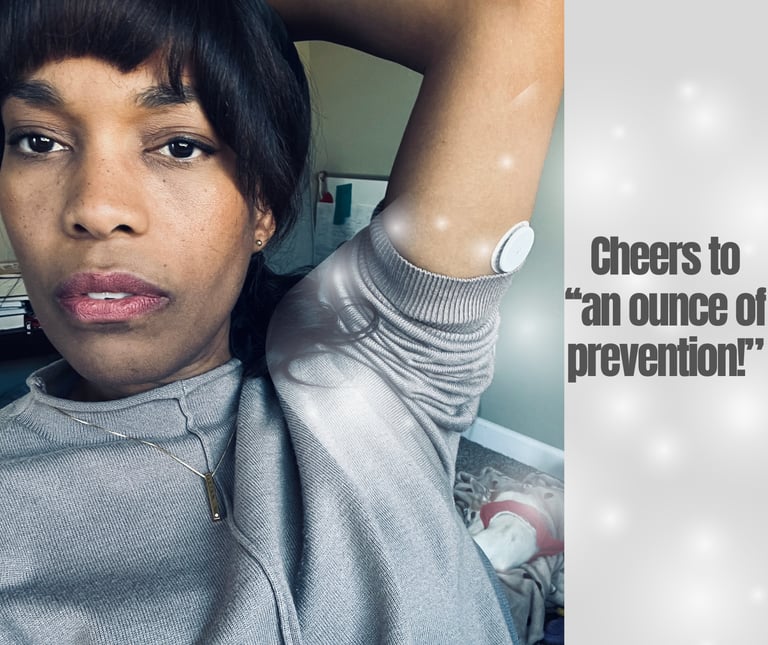
If you are like most Americans, you probably know at least one person living with type 2 diabetes. Many of us also have it woven into our family histories. Because preventative health is something I take seriously, and because both my husband and I have type 2 diabetes in our lineage, I decided to take a proactive step and try continuous glucose monitors, or CGMs, after attending the Longevity Fest. One speaker shared that she has all of her patients begin their health journey by wearing a CGM for about a month to better understand how their own bodies respond to food. That idea really stuck with me. Instead of guessing or relying on generic nutrition advice, we could gather real-time feedback from our own physiology. That felt empowering.
Wearing a CGM turned out to be surprisingly insightful. I started thinking of it as a little “hall monitor” for my blood vessels, quietly keeping an eye on the choices that might affect my long-term health goals. One of my biggest takeaways came in the evening. I noticed that when I ate larger portions at night, especially if dessert made an appearance, my blood sugar tended to stay elevated longer than I expected. Seeing that pattern play out on the app helped me connect the dots between nighttime habits and overnight blood sugar regulation. It did not feel punitive. It felt informative. With that awareness, I know I need to be more intentional about my evening routine and how I wind down for the night.
My husband had his own aha moment. Oatmeal, often marketed as a universally “healthy” breakfast, caused a noticeable glucose spike for him, even when it was unsweetened and frankly pretty bland. That experience reinforced an important concept: foods do not affect everyone the same way. We thoughtfully brainstormed that by pairing the oatmeal with fat and protein, like coconut oil and chicken sausage, this might soften the spike for him. We'll see what happens!
I also observed that when I had diluted apple cider vinegar in water before a higher-carbohydrate meal, my glucose response was more stable that time around. While that is simply my personal observation for that day and meal, having the data allowed me to see how small adjustments might matter for my body. I even noticed at least one glucose spike likely related to a stress response. Now I really need to apply the scriptures about peace so my glucose won't spike!
If you are curious about preventative health and want more insight into how your body uniquely responds to food, wearing a CGM can be a powerful learning tool. The technology is easier to access than ever, and the apps make the data approachable rather than overwhelming. Knowledge is not about fear. It is about clarity. When we understand our numbers, we can make more informed, compassionate choices for ourselves. We have the technology. We might as well use it to support better health, one data point at a time.